
You notice a new spot on your skin and your first thought is the worst one. It is a completely natural reaction, and you are far from alone in having it. The reassuring truth is that the skin produces all sorts of marks, bumps and patches throughout adult life, and the large majority of them are entirely harmless.
The difficulty is that, to the untrained eye, many of these harmless growths can look unsettlingly similar to a mole, and some can even be mistaken for something more serious. In this article we explain the most common benign (non-cancerous) skin spots people confuse with moles, how they tend to differ, and the point at which it is sensible to have one looked at properly rather than guessing at home.
In short: A mole is one specific type of skin growth, but skin tags, freckles, age spots and seborrhoeic keratoses are common, harmless marks that are often mistaken for moles. They differ in how they look and feel, where they appear and when they develop. None of them can be diagnosed with certainty by eye alone, so any spot that is new, changing or simply concerning you is worth a professional assessment.
First, what actually is a mole?
A mole is a small, usually brown mark made by a cluster of pigment-producing cells in the skin. Moles are typically round or oval with a smooth edge, and they can be flat or raised, smooth or rough, with some having a hair growing from them. Most adults have several, and the great majority are harmless. You can read our short explainer on what a mole is for more detail.
The marks below are not moles at all, even though they are often mistaken for them. Knowing the typical differences can ease some of the worry, though, as you will see, it is never a substitute for a trained eye.
Skin tags
Skin tags are soft, skin-coloured growths that often look as though they hang off the surface of the skin. According to the NHS, they are very common and usually small and harmless, are typically the same colour as your skin or a little darker, and frequently grow where skin rubs together or where there are folds, such as the neck, armpits and groin. They range in size from around 2mm to 5cm, and you may have one or a whole cluster.
How they tend to differ from a mole
- Texture and shape: a skin tag tends to dangle on a small stalk, whereas a mole usually sits flat against or raised within the skin rather than hanging from it.
- Colour: skin tags are usually skin-coloured or slightly darker, rather than the defined brown of a typical mole.
- Location: they favour areas of friction such as skin folds.
The NHS advises against trying to remove a skin tag yourself, as this risks infection, bleeding and scarring. If a tag bothers you or you are unsure what it is, it is better to have it assessed.
Freckles
Freckles are small, flat brown spots that appear on skin exposed to the sun. They are caused by sun exposure and genetics, are more visible after time outdoors, and are most commonly seen on the face, arms and other sun-exposed areas. A characteristic feature is that they often darken in summer and fade in winter.
How they tend to differ from a mole
- Size and texture: freckles are usually very small and completely flat, while moles are often slightly raised and more defined.
- Behaviour with the seasons: freckles tend to fade when sun exposure drops; moles do not.
- Reassurance: freckles themselves are benign and do not turn into skin cancer. They can, however, be a sign that your skin is sensitive to the sun, which matters for your long-term skin health.
Age spots (solar lentigines)
Age spots, known medically as solar lentigines and sometimes called sunspots or liver spots, are flat, well-defined patches of darker skin caused by years of sun exposure. They most often appear on areas with the most cumulative sun exposure, such as the face, hands and shoulders, and they tend to develop in later adulthood.
How they tend to differ from a mole
- Cause and timing: they reflect accumulated sun damage and tend to appear in later adulthood, rather than the childhood and early-adult years when most moles develop.
- Appearance: they are flat patches that are generally larger than a freckle and, unlike freckles, do not fade away in winter.
- Why they still matter: age spots are benign in themselves, but the British Association of Dermatologists notes they are a marker of accumulated sun damage, and that skin with many such marks can also be where an early skin cancer (lentigo maligna) develops. They can be difficult to tell apart from early skin cancers by eye, which is exactly why a professional look is valuable.
Seborrhoeic keratoses
Seborrhoeic keratoses (also called seborrhoeic warts or basal cell papillomas) are harmless thickened growths that become more common with age. The Primary Care Dermatology Society describes their classic feature as a “stuck-on” look, as though the growth is sitting on top of normal skin and could be picked off. The surface is often scaly, greasy or warty in texture, and the colour can range from pale yellow-brown through to dark brown or black.
How they tend to differ from a mole
- Texture: the rough, waxy, “stuck-on” surface is quite different from the smoother surface of a typical mole.
- Age: they are most common from middle age onwards and often appear in numbers.
- An important caution: darkly pigmented seborrhoeic keratoses can be genuinely difficult to distinguish from a melanoma, even for clinicians using the naked eye. This is one of the clearest reasons not to rely on self-diagnosis.
At a glance: how these spots typically compare
This table is a general guide to typical features only. It cannot diagnose any individual spot, because there is real overlap between these growths and, in some cases, between them and skin cancers.
| Spot | Typical look | Usual texture | When it tends to appear |
| Mole | Round or oval, defined brown mark | Smooth or slightly raised | Childhood to early adulthood, mostly |
| Skin tag | Skin-coloured, appears to hang off the skin | Soft, often on a stalk | Any adult age; favours skin folds |
| Freckle | Small, flat, light-to-mid brown | Flat; fades in winter | From childhood; sun-exposed skin |
| Age spot | Flat, well-defined darker patch | Flat; does not fade in winter | Usually in later adulthood |
| Seborrhoeic keratosis | “Stuck-on” growth, tan to dark brown or black | Rough, waxy or warty | More common from middle age |
When a spot does need a professional look
Most of the marks above are harmless. The problem is that no one can be certain which spot is which by sight alone, and the features that distinguish a benign growth from an early skin cancer can be subtle. The following situations are worth a specialist assessment rather than watchful guessing:
- A spot that is changing: any growth that is altering in size, shape or colour over weeks or months.
- A spot that stands out: one that simply looks different from your others. Dermatologists call this the “ugly duckling” sign, and it is taken seriously even when a spot does not tick other boxes.
- New symptoms: itching, bleeding, crusting or a spot that will not heal.
- A new spot in later life: a genuinely new pigmented spot appearing in adulthood.
- Simple uncertainty: if a mark is worrying you, that on its own is reason enough to have it checked.
Skin cancer is common in the UK. Cancer Research UK reports that melanoma skin cancer accounts for around 5% of all new cancer cases in the UK, with around 9,500 new cases in females and around 9,900 in males each year (2019, 2021-2022), and that rates have risen by around a quarter over the last decade. The encouraging counterpart is that, as our mole checking information explains, when melanoma is found early it can usually be treated successfully. That is the whole case for getting an uncertain spot looked at sooner rather than later.
Why a specialist assessment is worth it
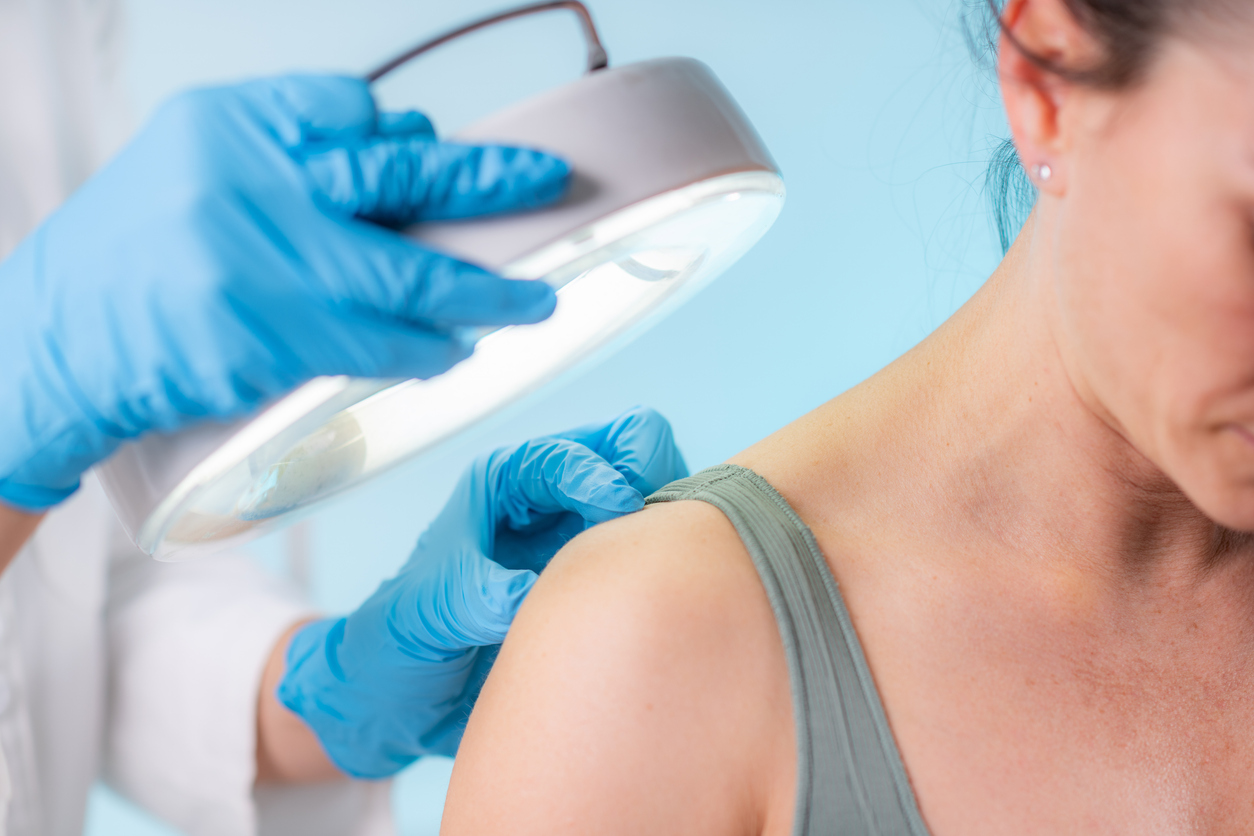
There is a clear limit to what any of us can tell from a mirror, a phone photo or a comparison table. A consultant dermatologist examines a spot in the context of your whole skin and your history, can use magnified examination to see detail that is invisible to the naked eye, and, where appropriate, can arrange for a sample to be examined under a microscope so that a firm diagnosis can be made rather than estimated.
At 108 Harley Street, our Skin Clinic has provided consultant-led dermatology since 1991. If a spot needs further attention, our consultants can discuss the options with you, including, where suitable, same-day minor procedures in our on-site day surgery. You can read more about what a mole check involves, or explore the full range of our Skin Clinic services.
The bottom line
Most of the spots that appear on adult skin, whether moles, skin tags, freckles, age spots or seborrhoeic keratoses, are harmless. Learning how they typically differ can take some of the fear out of finding a new mark. What it cannot do is replace a trained assessment, because the features that separate a benign growth from something that needs treatment are not always visible to the untrained eye.
So if a spot is new, changing or simply on your mind, the most reassuring thing you can do is stop guessing and have it looked at. To arrange an assessment with one of our consultant dermatologists, you can book an appointment with the Skin Clinic
This article is for general information only and does not constitute medical advice. It cannot be used to diagnose any individual spot, mole or skin condition, and it is not a substitute for assessment by a qualified clinician. If you are concerned about any change to your skin, please arrange a consultation with a doctor or consultant dermatologist.